What this podcast has helped me to understand about the desegregation practice is that desegregation has the power to help many black and Latino children in underprivileged neighborhoods, but it’s mainly the adults who won’t allow this to occur. Hannah Jones gave her own personal anecdote about how her Iowa school’s desegregation policies helped her to seek out a better future for herself, as she was able to get a degree and escape poverty. She was also able to make many white friends. From her viewpoint, desegregation seems like an obvious answer. It worked for her, and she even has the data that shows how black kids were able to cut the achievement gap by more than 50% when they attended desegregated schools. However, it was noted that desegregation efforts have mainly stopped across the country because officials and parents simply do not care enough to ensure that all children get access to equal education. In fact, the desegregation in St. Louis only occurred by chance when state officials finally decided to make the Normandy School District unaccredited. And even when the transfer system to the Francis Howell School District was implemented, there were still potholes on the road to desegregation.
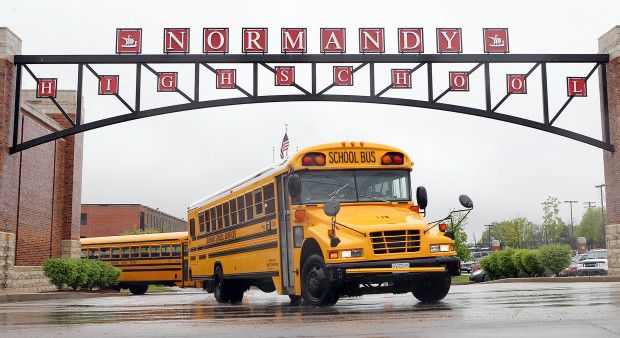
Listening to the discussions that the parents at Francis Howell were having at the district board meeting was the lowest point of the entire podcast. These parents kept insisting that “this wasn’t a race issue,” even though it’s clear that these people are indeed, very racist. The parents began to cheer as one mother said that they should implement metal detectors in the school, as she believed that the kids at Normandy High did nothing but take drugs and stab each other all day. A father was applauded for suggesting that they should move the start time up 20-40 minutes in order to make sure the kids from Normandy are unable to come to the school. Listening to these parents speak kind of made me imagine that this is what attending a KKK meeting in the 60s. I was shocked at how openly racist these people were in this time and age, and it helped show me that societal racism was another reason desegregation occurs at a sluggish pace.
Desegregation is also hampered by incompetent state officials and superintendents who don’t want to admit defeat. While it could be seen as admirable that the superintendent, Charles Pearson, is working hard to bring Normandy back up to state standards, he and other state officials fail to see that childrens’ lives and futures are at stake during this rebuilding process. The kids at Normandy High will still not be receiving a proper education, and instead of allowing the students to improve their lives and attend better schools, the state of Missouri completely changed up the crediting system in order to trap the students in the Normandy District and keep them from reaching the American Dream.
One thing I did find endearing from the podcast was how the children at Francis Howell treated the kids coming in from Normandy High. When Mah’Ria said, “I actually kept telling myself, ‘The parents aren't the one that's going to the schools. It's the kids. Keep reminding yourself that,’” I remember my stomach dropped because I had thought that those kids would be even more mean than the parents had been. I thought they would have adopted their parents’ mannerisms and started antagonizing and bullying the transfer students. However, I had never been more glad to be wrong. On the first day of school, the cheerleaders were waiting for the transfer students to walk in and started cheering them as they arrived. The students were also kind and friendly, such as Brittany, who introduced herself to Mah’Ria and became one of her best friends. This also helped me realize that it is up to our generation to continue the process of desegregation and to not get caught up in the viewpoints of our ancestors. We need to keep pushing on and moving towards progress. As Asagai said, “progress… is simply a long line… one that reaches into infinity.” It’s up to our generation to keep walking forward into the future.
I really liked "potholes on the road to desegregation". It was a really nice metaphor that started the blog off strongly. Your thoughts and analysis on desegregation, as well as how you ended it with a quote from Asagai was also insightful. There is still very much to be done about this issue!
ReplyDeleteNihil, I agree that it was truly inspirational for the kids' behavior to contrast their parents' viewpoints on African-Americans. It is really important for us to try to make change happen, instead of waiting for change to happen.
ReplyDeleteNihil, I loved the connections you drew from the podcast and A Raisin in the Sun. I also agree that moving forward is incredibly important for change. Dwelling on what happened will not do anything to bring change. It also shocked me how the parents felt so strongly and had essentially no compassion or sympathy towards the students. It clearly isn't their fault, and they should not be blamed.
ReplyDelete